The American’s are next to play a card. The American is starting to become concerned about Cornwallis in Virginia. The spreading British influence is starting to become a problem. Let’s take a quick look at the map to get our bearings:

General Green with a full army of 5 units has accomplished the mission of bolstering the American political cause in and around New York. With just 4 cards left in hand the American needs to be aware of the Winter phase. In the winter phase all American Armies, except for Washington’s Army, will suffer 50% winter attrition. The militia will head home for the harvest season. This means General Greene’s army is going to evaporate very soon. It is probably best to lose them now in combat (maybe take out a few Redcoats) rather than let them just walk away for the winter.
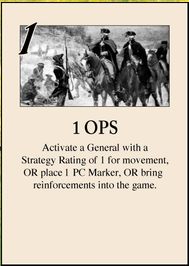
The American plays a 1 OPs card to activate General Greene. Greene moves South with the goal of bringing Cornwallis to battle. Greene will take advantage of the “special American mobility advantage” feature in the game. An American general can move 5 spaces instead of the normal 4 spaces as long as he is not engaging an enemy. Greene makes it all the way to Alexandria.

General Greene is now just 2 spaces away from General Cornwallis. This ends the American’s card and play switches back to the British for the next card. The American play has put Britain in a strategic quandary. Should Cornwallis flee South? Doing so is probably just delaying the inevitable battle and giving up favorable ground. He would run out of map room after just one turn and become cornered. General Green can eventually bring him to battle.
Does Howe attack Washington up North? The British are holding a nice combat card to help out:
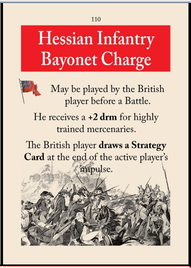
The +2 dice roll modifier would help to even the odds for Cornwallis or provide Howe a nice boost to defeat Washington.
Losing Cornwallis in the South would, I think, be the bigger problem. Without troops in the South, political control would quickly start to shift America’s way. The British decide to stay and fight with Cornwallis. Cornwallis will therefore not waste a card moving and instead continue shifting hearts and minds in the South.

With 2 OPs the British flip 2 empty spaces to their way of thinking. Yorktown and Georgetown each get a British PC marker.
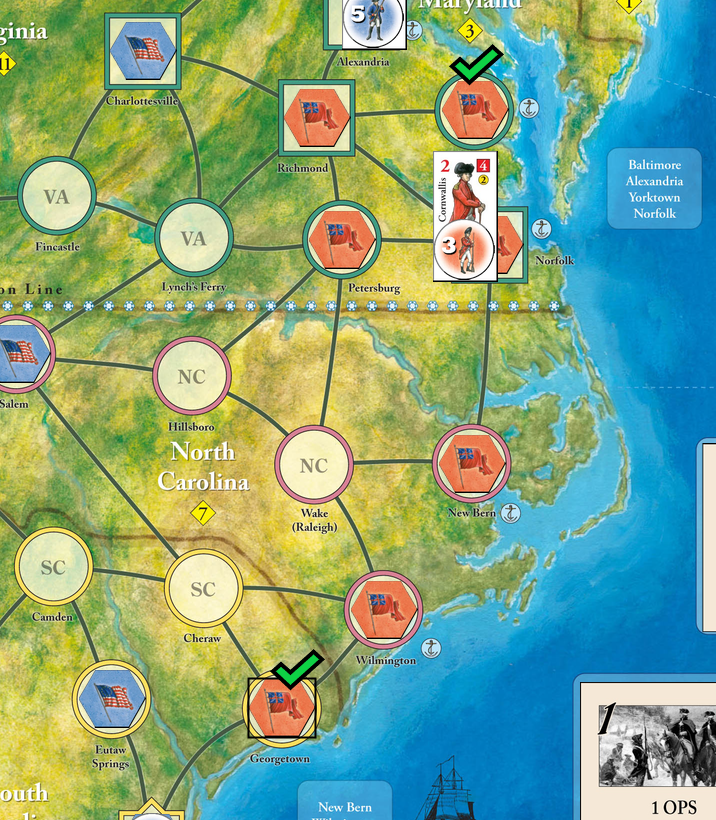
The American is next. A 3 OPs card is played to activate General Green and 5 combat units. They move from Alexandria to Norfolk where our first battle of the game will take place.

It always feels like a bit of a waste to play a 3 OPs card to activate a General with a 1 Strategy rating. In this case, it can’t be helped with only two 3 Ops cards and an event left in the American hand. Here is the movement:

Greene and Cornwallis are pretty evenly matched in battle. Each have a “potential Battle rating” of 4 and an “agility rating” of 2. This should be a close fight. As stated earlier, General Greene is going to lose 2 units to attrition at the end of the Strategy Phase and would like to get some redcoats before his militia departs. Like most wargames there is a battle procedure pointing towards a few tables to roll on: Here is the procedure:

In step 1, both sides commit cards to the battle. General Greene does not have a battle card but does have an unused event card that can be played. The Brits fortunately have a battle event card to play. These cards give the American +1 and the British +2:

The American card is actually a British event which is unpleasant to the Americans. Playing it as a battle card gets it out of the American hand and prevents it from being “bought out” of the discard pile by the British. Unlike a battle event card, however, it does not provide a card draw to the American. The British on the other hand get to play their battle card and replace it afterwards with a fresh card draw.
Next both side roll to determine their General’s Battle rating using this very simple table table:
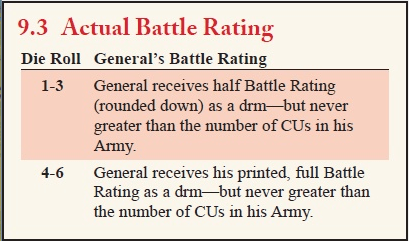
Each General has a potential battle rating of 4. Lets roll and see what the actual rating ends up being. Both Generals roll 6s so each will get to use their full battle rating of 4. The cumulative modifiers are now +5 American and +6 British.
Now we look at the general DRMs from this chart to add any that we have not already accounted for above:

Greene has +5 for combat units to add to his modifiers already calculated for a total of +10. Cornwallis will get +3 for his units and also +1 for having British Regulars, +1 for Militia (most PC markers in Virginia) and since the battle is taking place in a port they get +1 from Royal Navy Support for a total of +12 to his roll.
Having political control of the region and remaining in a port location has swung the balance in Cornwallis’ favor. General Greene will need to roll well to win. Dice are now rolled.
Greene rolled a 4 and Cornwallis rolled a 5 making him the victor with a total of 17 to Greene’s 14. We now must determine losses by rolling on the Combat Losses table:
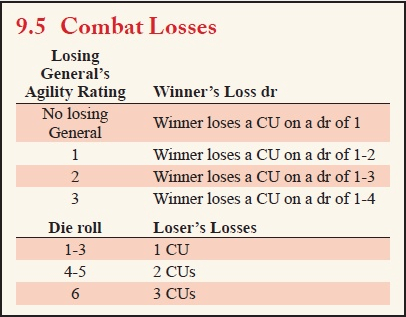
Greene rolls another 4 and will take a loss of 2 combat units. Cornwallis rolls a 3 with his agility rating of 2 so he will take 1 combat unit loss. General Green must retreat and does so by going back to Richmond.
The British draw 1 card to replace the played battle card. We will leave things here until the next post. It was cool to get to have a battle. Cornwallis took advantage of the Port location and stayed in a region where the British have established local control and that made the difference in the outcome. I am looking forward to see what happens in the next post.
 Strategic Buffoonery