The British enjoy a card advantage as we head towards the end of the first turn. They are holding a couple of 3 OPs cards and 1 event card. The British have been paying attention and know that the American has only 1 card left to play. This will give the British 2 consecutive Operations at the end of the turn; a nice advantage as the turn expires. The Brits begin by playing their event card:
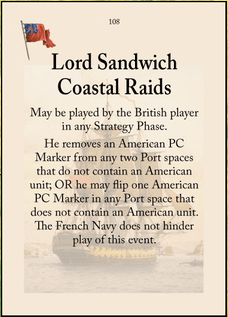
There are 2 options and the British elect to flip New York City back to British political control. Having a port in New York feels pretty critical and being able to flip it without taking a turn to place an army in New York seems pretty good.
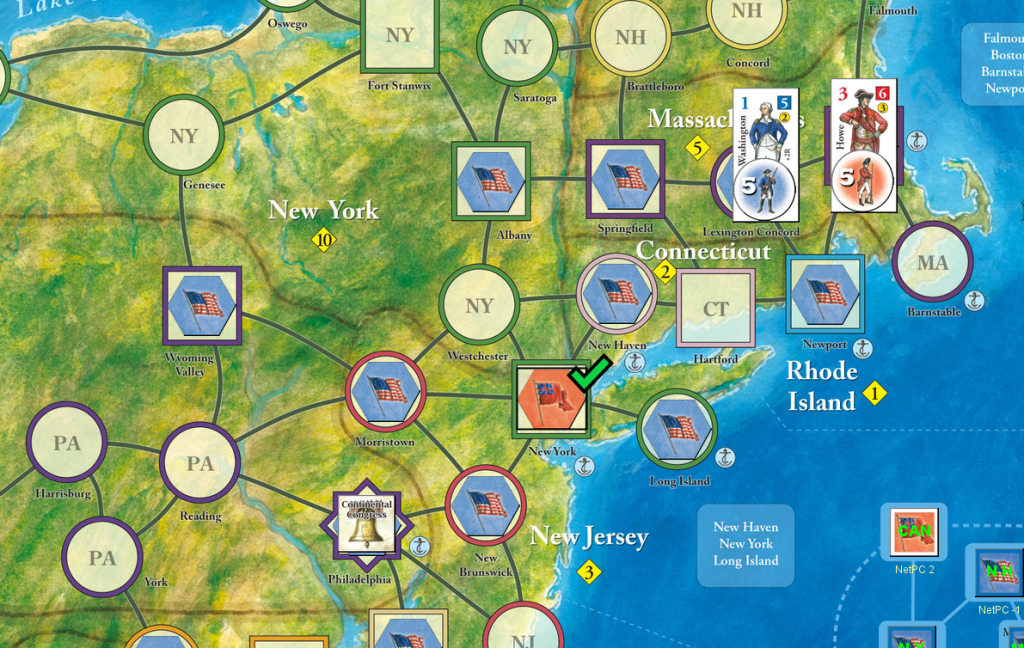
The American is up with their last card. Note that you are not allowed to pass and hold a card so the American is compelled to play the remaining card now.

There is an important topic we have yet to discuss that is becoming increasingly relevant in this game. Your political control markers are subject to becoming “isolated.” If a marker is isolated at the end of a turn then they are removed from the map. An American political control marker becomes isolated if it cannot trace a path to:
- an uncontrolled space that does not contain a British
CU, or - a space containing the Continental Congress, or
- an American controlled space containing an American
or French CU, or - an American controlled space containing an American
or French General.
Note that an American General on a British space is not a valid source for maintaining an isolated marker. The British player has similar rules with the addition of all ports being a valid trace location. Its that naval advantage paying off once again for the Brits.
Since we are approaching the end of the turn it makes sense to evaluate the map to see if we are at risk of losing our hard earned political control markers. Here is the current situation:
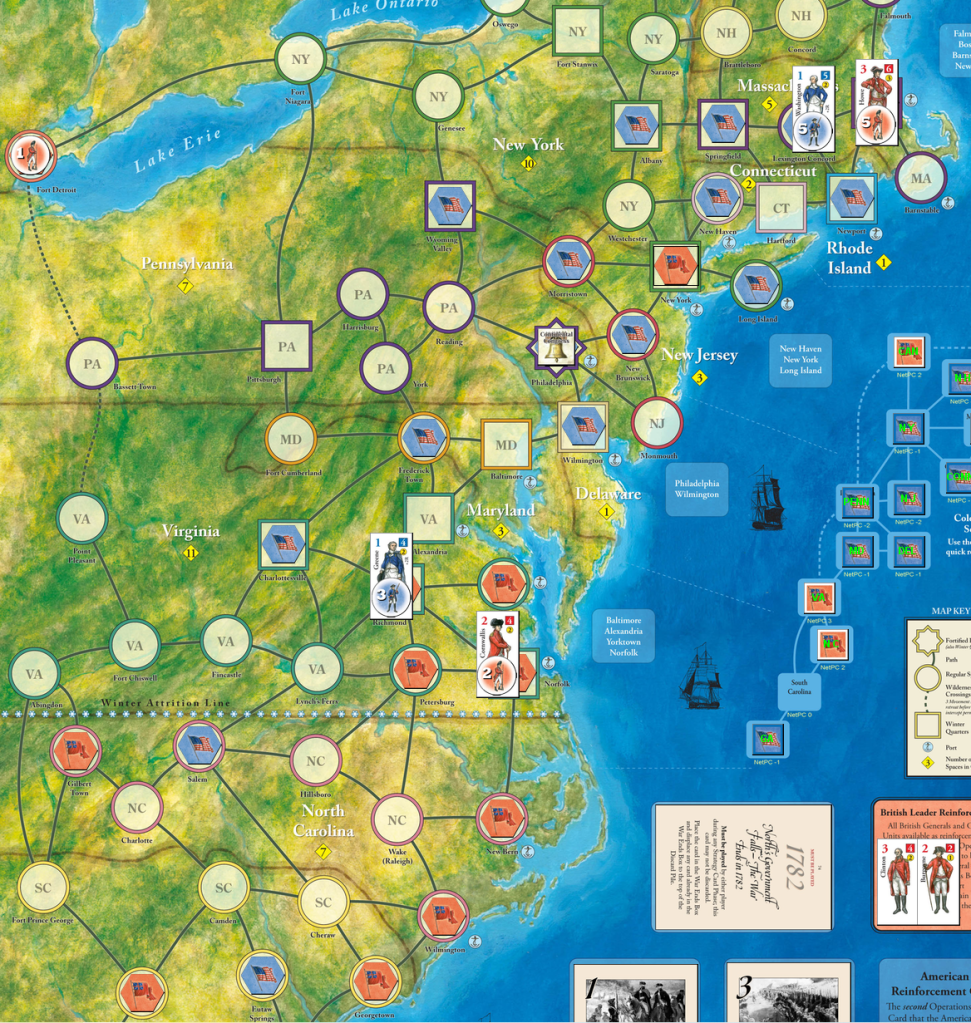
After some consideration and head scratching the Yanks settled on Richmond, Lynch’s Ferry and Brattleborow. Richmond was flipped primarily because General Greene is not a trace location if his space is not American. By flipping Richmond, Greene can maintain any marker that can trace a path to him. The Brattleborow marker was placed to link up the Northern markers and to block east west placement of markers from General Howe’s location. The marker in Lynch’s Ferry also connects markers with General Greene preventing other markers from being easily isolated and removed. Here is a zoomed out map with the locations checked.
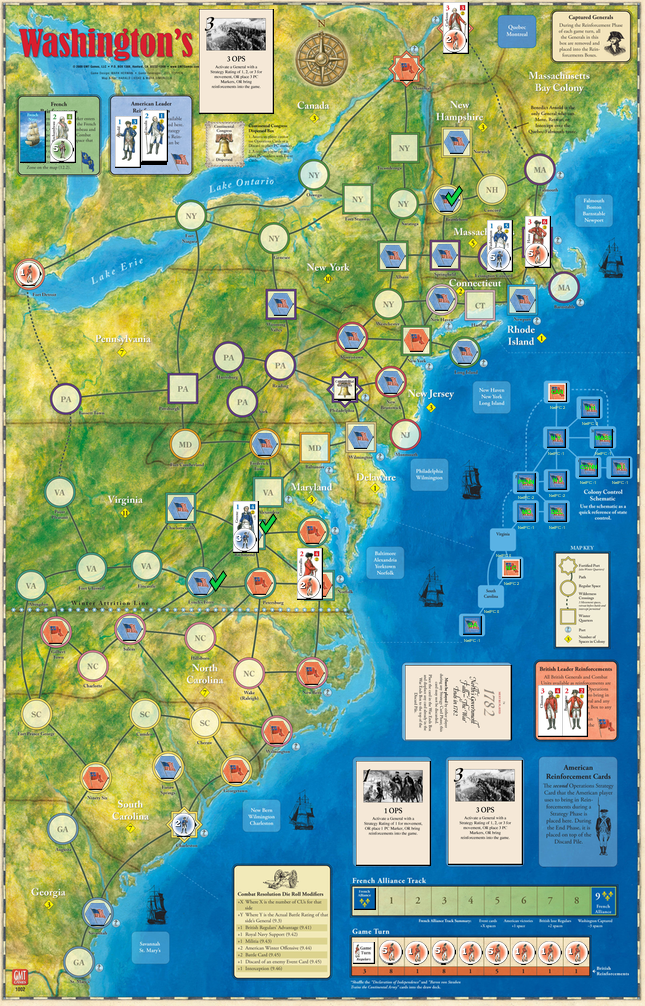
Brits are up and they play a 3 Ops card for 3 political control markers. At present the Americans control most of the colonies. The Vassal interface keeps track of who controls each state with a “Colony Control Schematic” printed out in the Atlantic Ocean. It shows which side owns each state at a glance. Here is the current status of political control:

The Colony Control Schematic updates as tokens are placed on the main map. Britain has work to do, at present they only control Canada and North Carolina. Spending Ops to control of a few more states seems like a good play for Britain.
Bassett Town, Abingdon and Fort prince George each get a British control marker with the first 3 Ops. America is out of cards so we will do it one more time. The Brits play their second and final 3 Ops Card to place 3 more control tokens. This time it is Pittsburg, Oswego and Ticonderoga giving the British control over Virginia, South Carolina and New York States.
Both sides are out of strategy cards so that ends the Strategy Phase of Turn 1. The basic concepts for Washington’s War have now been covered. Anyone reading this should have a decent idea of how the game plays. I will wrap up turn 1 up in the next post and maybe offer some final thoughts on this interesting game.
 Strategic Buffoonery