Categories
Nevsky Strategy Gaming Tabletop Board Game

Exploring Nevsky: A Board Game of Medieval Strategy / Part 4

We begin with the Russian Lords playing their 2nd card. The Russians draw Vladislav again. We will continue with our plan to cross the border and begin ravaging the Teutonic lands. Vladislav uses his first 2 commands to continue his march westward. He uses his last command for the turn to ravage Wierland. This gives him a provender and 1/2 VP for Russia.
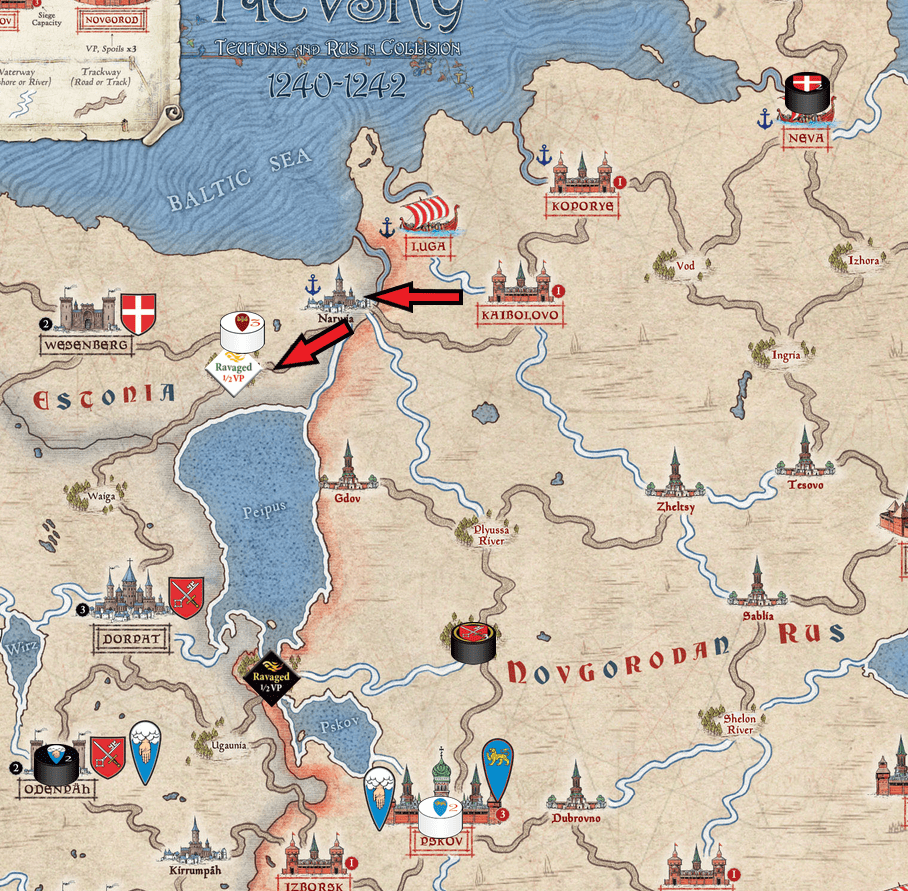
Since Vladislav marched he gets a moved fought counter. Conveniently he just picked up a provender from the ravage so he can once again feed his hungry troops.

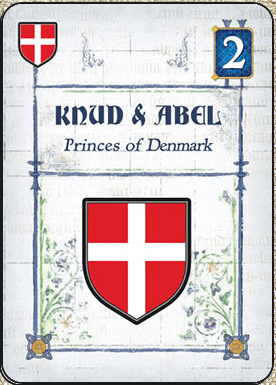
Incidentally, large armies with more than 6 units require 2 provender to remove the moved fought marker. This is going to be a problem for Knud & Able as they have 7 units.

Vladislav has used all of his actions and fed his troops so the command card is discarded and play goes back over to the Teuton player. The Teutons draw the next card from their command deck:

Hermann is up again. He has three actions and an interesting decision to make. He is in range and could intercept Vladislav and try to put an end to his counter-raiding with a battle. To do so Hermann would have to march twice (using boats) to reach Narwia then take the track to West to intercept Vladislav in Wierland.

Hermann, however, would have to abandon his provender in Narwia because he did not levy carts so can not haul provender across land. This means he would arrive in Wierland without provender to feed his troops.

The other problem with this option is that Hermann would have to forgoe ravaging in Russia which was the game plan. No ravage, no VP.

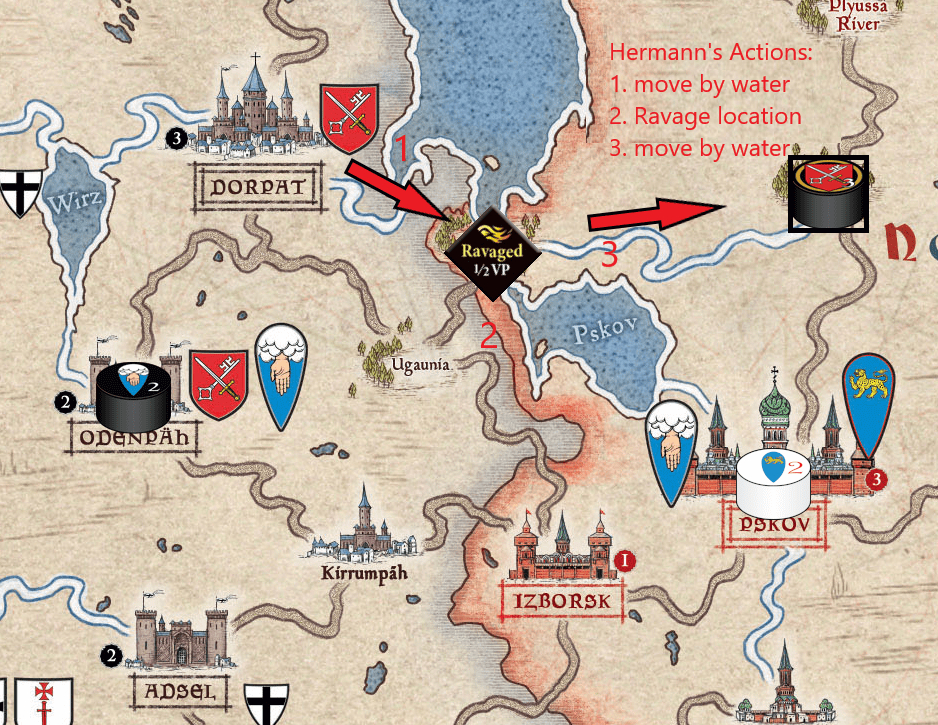
Hermann decides to stick with the plan. He uses a command to ravage his current location at Zhelcha River. Next, he marches North to Plyussa River but must leave behind the provender he obtained by raiding Zhelcha River. Again no carts so he can’t haul all of the food. The final command is used to ravage Plyussa River and by doing so obtains 1 provender and can feed his troops. The 2 ravage commands give the Teutons a total of 1 VP.

We have briefly discussed the consequences of hungry troops in past posts. Given that Hermann had to abandon provender this turn, I thought it would be good to explain how hungry troops reduce a lords service.

There is a calendar on the top of the game board that is used to track lord service time, game turn and victory points. This image is the part of that calendar covered by this scenario.
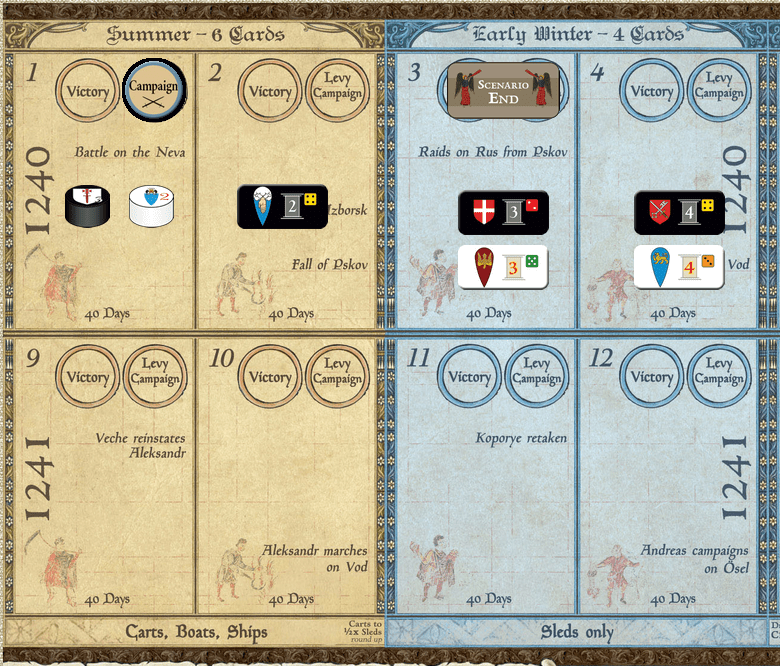
We are currently in the Campaign Phase of Turn 1. You can see the blue circled marker currently on its “campaign” side in box 1. You use this marker to keep track of the turn and the phase. It’s on its “Campaign” side; the other side reads “Levy.” When the turn advances we will flip the marker back to its levy side and place it in the turn 2 box.

The two cylinders in box 1 are lords that could have been potentially mustered in this scenario. We did not spend levy actions to attempt to muster either of these lords so they remain in their keeps.

Each lord also has a rectangle shaped service marker that bears that lord’s unique crest. Russian markers are in white and Teuton markers are black. The service marker shows the lord’s service rating and fealty roll. The service rating is the number of turns the lord will serve before returning home. The dice icon is the fealty roll. It shows the number or lower required on a roll to muster that lord. It is good that Knud & Able started the scenario mustered because you would need a roll of 2 or lower to muster them.

A player that can’t feed his troops after move or fight commands must shorten the affected lords service by a turn. To show this, the service marker is slid left on the calendar to track the loss of service time. If a lords service marker is in the current turn’s box, then that lord must disband unless the player can pay to extend the service. Payment to extend service is usually with coin gained through the tax command.

Categories
Nevsky Strategy Gaming Tabletop Board Game

Exploring Nevsky: A Board Game of Medieval Strategy / Part 3

It is the Russian’s turn to pull a card from their command deck. We pull Lord Vladislav’s activation card. He will get 3 commands. The problem is trying to figure out what to do with these commands. We know the Teuton Lords will continue to attack and raid. We need to find a way to counter the Teutons before they accumulate too many victory points through ravaging. Let’s take a look at the Northern part of the map:

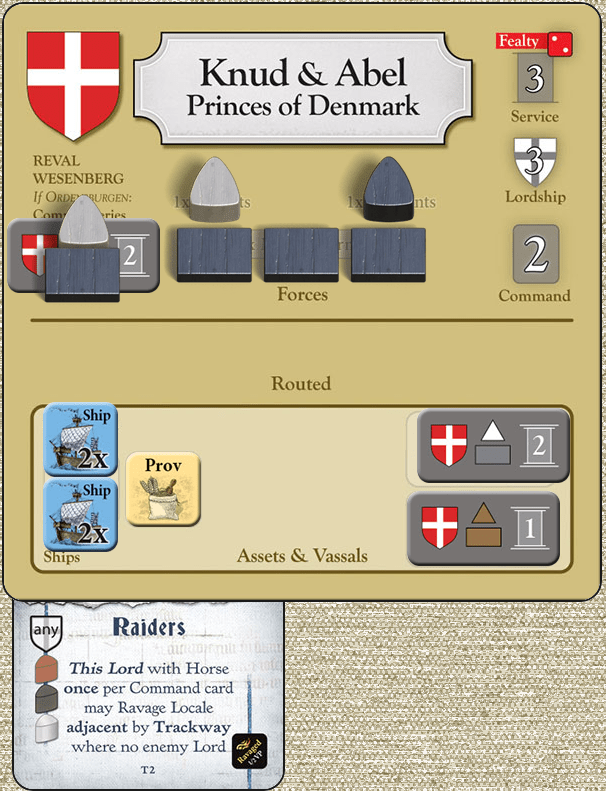
Hermann is active to the South but he levied boats for his transport so it is likely he will stick to the waterways. He is blocked from going North or East from his current location unless he drops his provender. Hermann did not levy carts. Knud & Abel are in the Far west but they have access to ships. Knud & Abel’s play mat shows their muster activity:

Knud & Abel mustered 1 vassal and 2 ships. They have enough ships to sail with all the cavalry units on their mat. Teutons need 1 ship per horse unit and this is exactly what they mustered. Three ships to haul the horses and 1 for the provender. Odds are good they will sail with their first activation. I have this on good authority since I am playing both sides of the game. Sailing takes the whole activation card but would allow Knud & Abel to land at any northern settlement with a port.

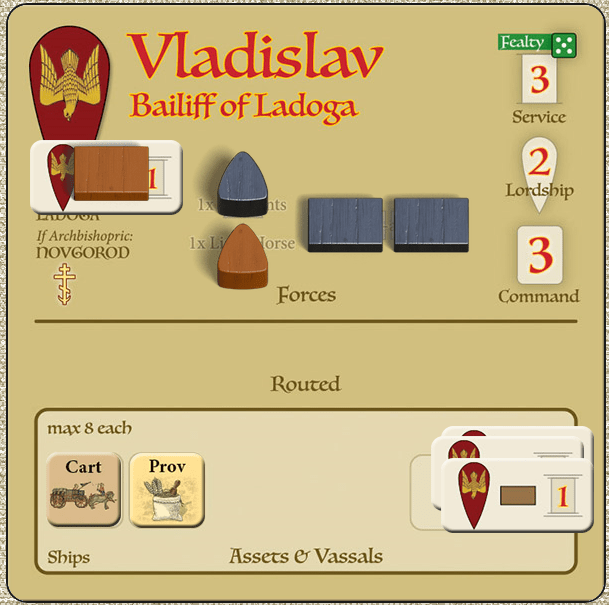
It is questionable whether Vladislav has the troops to win a battle against Knud & Abel who have powerful knight units. Vladislav’s levies are less capable:

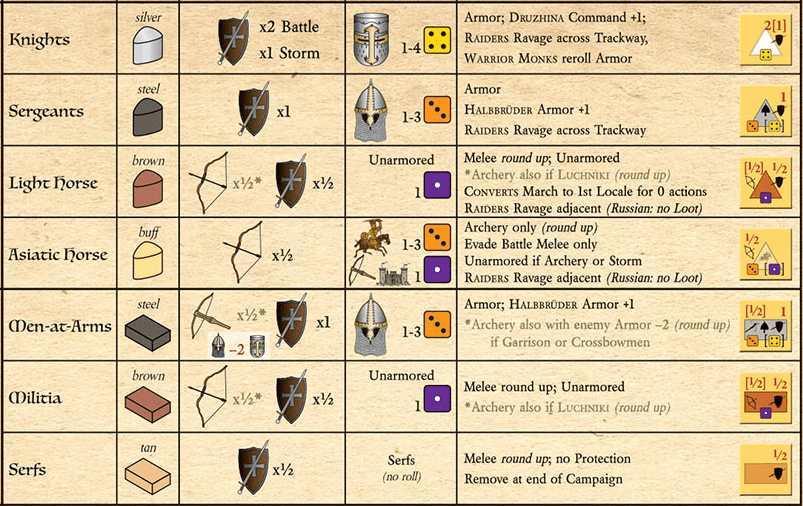
The triangle pieces are cavalry units and the rectangle pieces are foot units. Here is a chart that shows the capabilities of all the units in the game:

The 4th column shows armor ratings for the various units. Any unit suffering a hit makes an armor roll using these ratings. A dice that comes up in the range listed on the armor table cancels the hit. You can see here that knights cancel hits with a roll of 1-4 making them the most armored unit in the game and very difficult to kill. Vlad cannot go toe-to-toe with the Teutons as things currently stand, the knights are too powerful. Losing a battle would give even more victory points to the Teutons so we need to find another way.

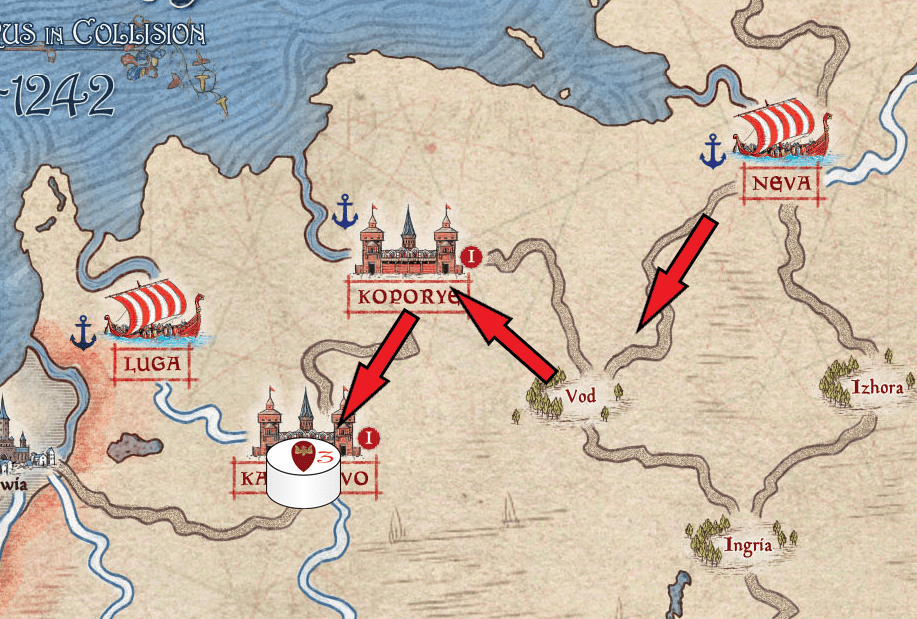
Instead of defending and battling we could focus on counter-raiding the Teutons. We can ravage the west and claim victory points to cancel their effort to raid. To ravage we need to be near Teuton territory so that means we need to move West.

This move puts Vlad on the border where he can use future commands to counter raid. Vlad used all three commands to march. This gives him the dreaded Moved Fought marker so he must feed his troops. He has a provender on his mat and uses it to feed his troops which removes the marker. He is fresh out of provender so finding more will be a priority during his next activation. There are command for this problem.

This ends Vlad’s activation and play returns to the Teutons who may once again draw a card.

The Teuton player draws Knud & Abel. Note that This Lord(s) only gets 2 commands in each activation. They are slightly less capable than Hermann or Vladislav. As anticipated Knud & Abel take the sail command.

This action (as noted in the requirements above) takes the entire command card to execute. Knud & Able sail up the black sea and land deep behind Russian lines at Neva. Sailing gives a unit the moved fought marker so Knud & Able spend their only provender to feed their sea sick troops.

Play moves back to the Russians. We will pick things up in the next post with the Russian response.

Categories
Nevsky Strategy Gaming Tabletop Board Game

Exploring Nevsky: A Board Game of Medieval Strategy / part 2

Since my last post the remainder of the lords on the map have used their muster actions. The two Russian lords mustered their own vassals to increase their troop strength. The Teutonic knights also mustered vassals and in addition, Lords Knud & Abel mustered ships.

Now that we are properly geared up, the Teutonic invasion of Novgorodian Russia can begin. Let’s get oriented first:

The Teuton Lords are represented by black cylinders on the map; the Russian Lords are white cylinders. You may have noticed the gold ring around Herman’s marker. This denotes his status as a marshal. He can command other lords (take them with him) during his actions.

The map shows Teuton lands with a grey tint while the Russian lands have a reddish tint. To take levy actions a lord must be in a friendly locale when the Levy Phase begins. The only way to make an enemy side of the map a “friendly locale” is to conquer an enemy stronghold.

To win the game you must collect more victory points than your opponent. You gain those victory points by ravaging enemy holdings, destroying their armies and conquering their strongholds. In this short scenario the Russian player starts with 1 VP already in the bank. The onus is on the Teuton Lords to invade. Let’s get to it!

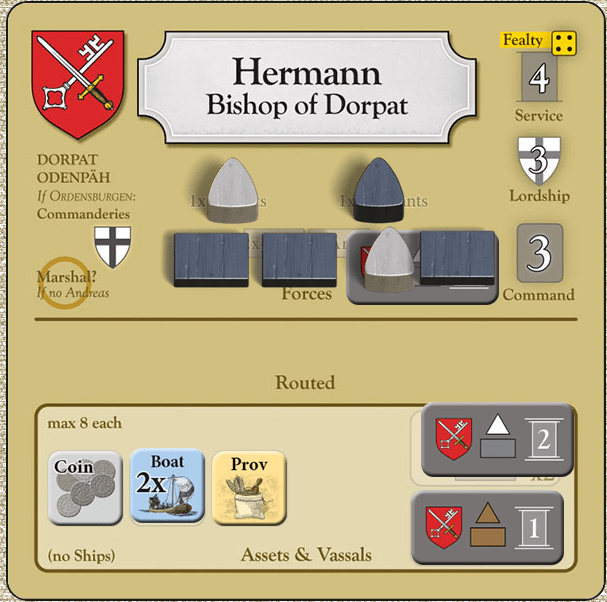
Before we start stomping about the map each side must create a command deck. You build command decks from command cards; each lord has three. This is what one of Hermann’s command cards look like.

Lord Hermann’s Command Card

It is currently summer so our command deck needs to have 6 command cards. The deck is made from command cards for the lords who are currently in play. You make a new command deck for each successive campaign season.

Players will take turns drawing cards from the command deck to determine which lord is up next. The cards also show the Lords Command Rating. Hermann has a command rating of 3 which represents the number of commands he may take when his card is drawn. Players alternate drawing command cards from the deck until they are gone. Once both players’ decks are empty, the Campaign Phase of the turn ends.

Here is what is in the Teuton’s command deck looks like:

Teuton Command Deck

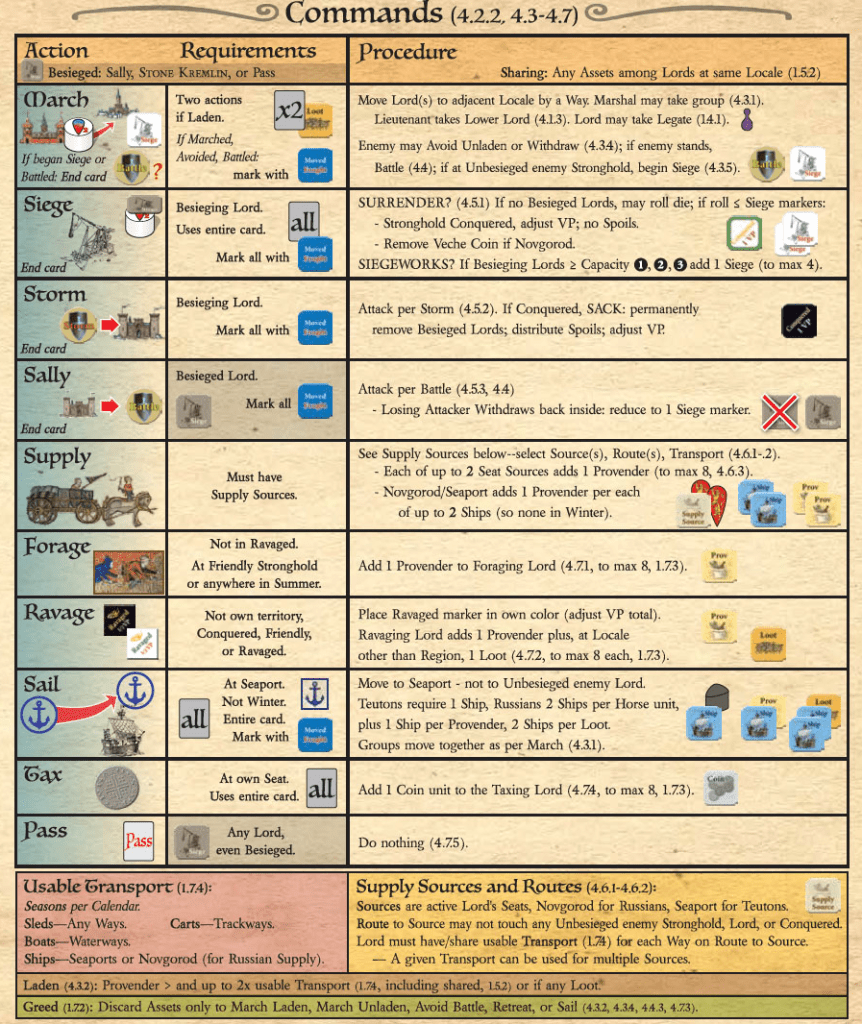
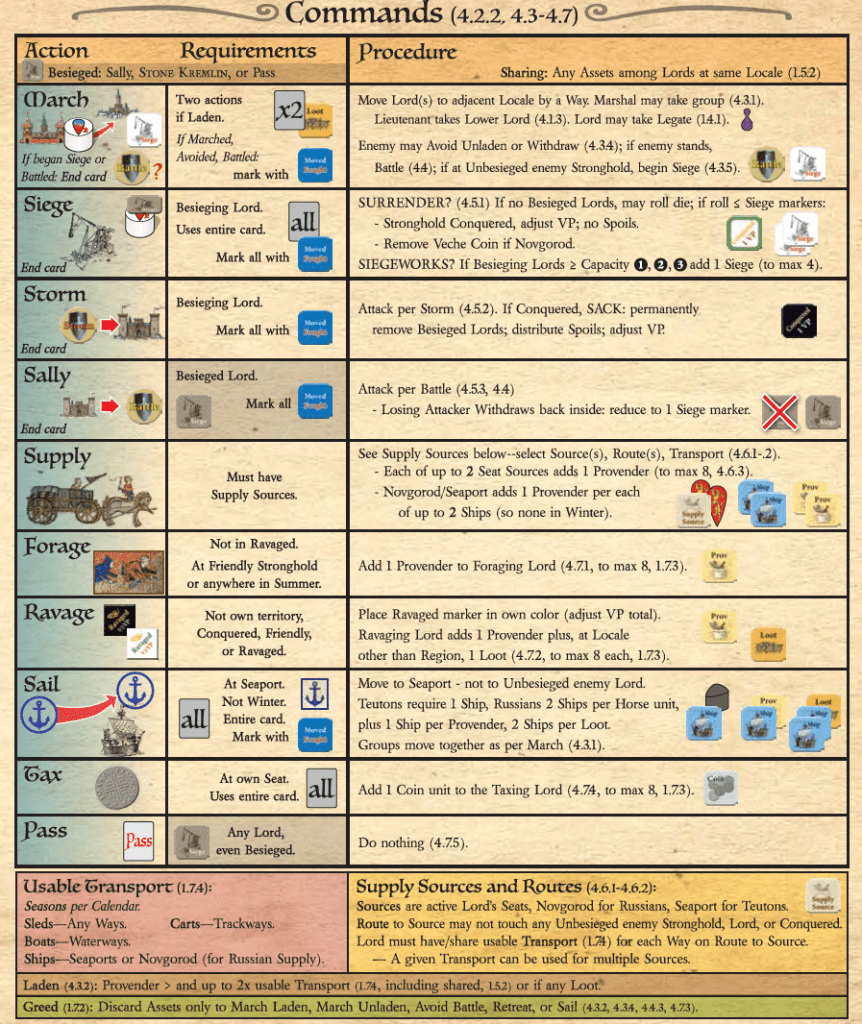
In Nevsky the Teutons go first (they started the crusade) so we draw Hermann’s first command card and he gets to select 3 actions from the following list of possible actions:

Commands Player Aid

In a previous play through of this scenario I moved Herman directly to the nearby stronghold of Pskov and placed it under siege. This did not work out well for several reasons. First, you only have 2 turns in the scenario to siege and storm. It is barely enough time so getting it done requires quite a bit of luck. That strategy leads to an all-or-nothing storming of Pskov for the win or defeat. For this playthrough, I am going to try instead to ravage my way to victory. I have no idea if this will work but I think its worth trying. We will soon see.

Hermann has the first card:

Herman takes the march action and moves (1) to Uzman by boat. The boat transport is necessary because Hermann is taking provender with him and it must be transported. Moving also tags him with a moved fought marker.

Next Hermann will ravage Uzman (2) which gives the Teuton side 1/2 VP (victory point) and Hermann gets another provender. This gives him a total of 2 provender which he can carry because he has the 2 boats on his mat. For the last command, Hermann will march again (3) to Zhelcha River where he intends to ravage when his next command card is drawn. Herman’s mat has changed since the start of his turn and now looks like this:

Since Hermann has a moved fought marker on his mat he must expend a provender to feed his hungry vassals and their troops. Hermann can then remove the Moved Fought Marker and end his activation. If Hermann could not feed his army, it becomes more likely his troops will quit the field and return home. Having unfed troops causes service duration reductions.

The Russian player is up next and will need to figure out how to respond to the ravage strategy. I will cover the Russian response in my next post.

Categories
Nevsky Strategy Gaming Tabletop Board Game

Exploring Nevsky: A Board Game of Medieval Strategy / Part 1

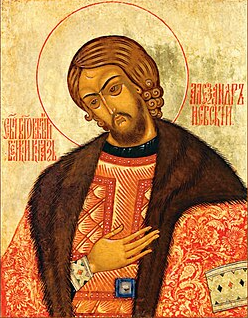
Nevsky is a board game designed by Volko Ruhnke and published by GMT Games. It is Volume I in the Levy & Campaign series of board games that explore operational aspects of medieval warfare. Nevsky explores the conflicts between the Teutons and Rus involving the game’s namesake Alexander Nevesky Nevsky whooped up on catholic crusaders in the 11th Century and became a Russian household name.

Napoleon said, “An army marches on its stomach.” A quote highlighting the often overlooked importance of getting necessary things to soldiers. Nevsky is a game that explores operational mechanics for medieval armies. In a game of Nevsky, you fail to pay, supply and support your troops at your peril. Nevsky also features opponents with differing capabilities. The Teutons and the Rus field very different armies. Learning how to best take advantage of the strengths of each army and manage their respective weaknesses is a big part of the game.

I would be remiss if I didn’t mention that the physical copy of the game is super cool. Nevsky uses uniquely-shaped, painted, wooden pieces to represent different classes of soldiers. These pieces are satisfyingly tactile to manipulate and shuffle about. All of the components are well-made and thematic.

The game art is perfectly evocative of the period and serves to give the game a satisfying medieval vibe.

I find all of this to be super interesting and so I thought I would play a game and share it here in my blog. I will be using the excellent Vassal module to play. While I do own a copy of the game and generally prefer to play with the physical version, sharing it would involve photography. I am not much of a photographer and using Vassal makes getting media for the blog much easier.

The game involves cards and quite a bit of hidden knowledge. This makes playing solo challenging. I will do my best to divide my brain equally between Teutonic and Russian. It should work well enough for this playthrough. Just know that Nevsky is designed for two-players and is way more fun enjoyed with another human.

I will be playing the short introductory scenario called, “Pleskau-1240” that lasts 2 game turns. This write-up is not a tutorial. There are excellent tutorials available on YouTube should you need one. I just wanted to share some gameplay of a fun game that I like. I will try to explain some of what I am doing as I go.

Levy Summer 1240

The game starts with each side randomly drawing 2 cards from the Arts of War deck. The Teutons pull:

At the start you get to add capabilities found on the bottom half of the card. The top half of the cards are for later so you can disregard it for now.

The Teutons get to add a raiding capability to one of their lords. What lord does not want bonus raiders? The other card adds the commanderies for the Teutonic Lords. Normally a lord has just one commanderie located at their keep. The card Ordensburgen grants additional bases of operation for all Teutonic Lords. We will see the usefulness of this capability as we play. Note the black crossed shield herald, you will see it on the map soon. The shield will be found on these bonus bases.

Let’s see what the Russians get:

Russian capability cards

The Russians get Luchniki (massed archers) and Druzhina (Elite retinue) both sound like fun. Since the cards have the “This Lord” wording we will pick a lord whose heraldry is found on the card to enhance with the card.

Lord Hermann’s “Lord Mat” before mustering

Next each lord in play gets to muster. A lord may muster a number of times equal to their lordship score. A lords scores are found on their lord mat. Lord Hermann gets 3 cracks at mustering. The following muster actions are available:

  • Roll to try and muster another lord
  • Muster a vassal from their mat
  • Muster a transport asset (boat, cart, sled, ship)
  • Muster an arts of war capability (select a card)

I will muster for Lord Herman while humming Eye of the Tiger. Your gear up theme music may vary. Lord Herman will do the following 3 actions.

  • Muster one of his own vassals
  • Muster a boat
  • Muster a boat
Lord Hermann’s mat after he has mustered for turn 1

Hermann added a vassal giving him more wooden bits (troops) and added a “2 x Boat” marker to his transport capabilities. With more troops and pile of boats Lord Hermann is locked and loaded.

Once all of the Lords have mustered the game goes from the Levy phase to the Campaign Phase. I will muster the rest of the lords so they are ready to begin the next phase. We will discuss campaigning in the next post.