In the last post, the British player used his one reinforcement for the turn to place General Cornwallis and 3 combat units in Norfolk Virginia. This created an open path to Philadelphia PA and the current home of the Continental Congress. Should a British combat unit enter Philly unmolested then it would disperse the Continental Congress. The Congress marker, if this occurred, would be placed on the turn track. While the Continental Congress maker is on the turn track, the American player is severely limited in the political actions they are allowed to take. This should be avoided by the American but is a worthy objective for the British.
Lets look at the map to get oriented:
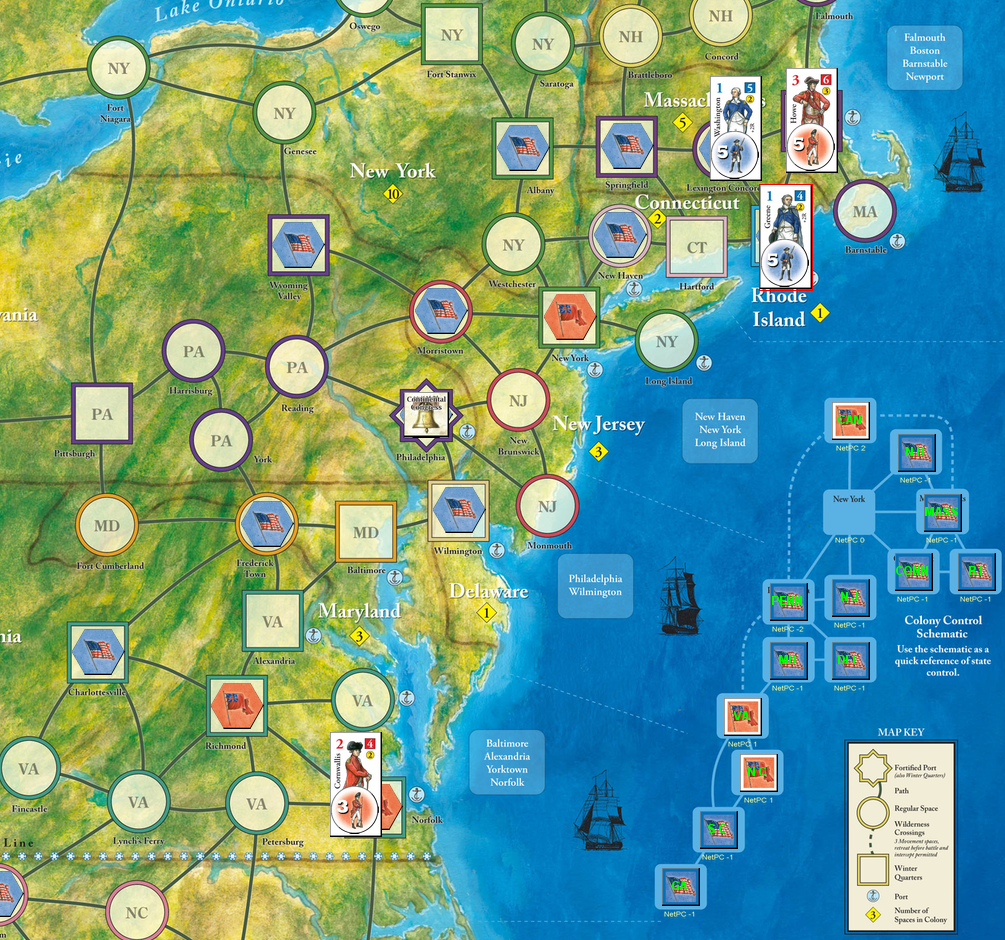
An army can move though 4 adjacent spaces when activated. This means that Cornwallis is 2 moves away from Philadelphia should he pick this as an objective.

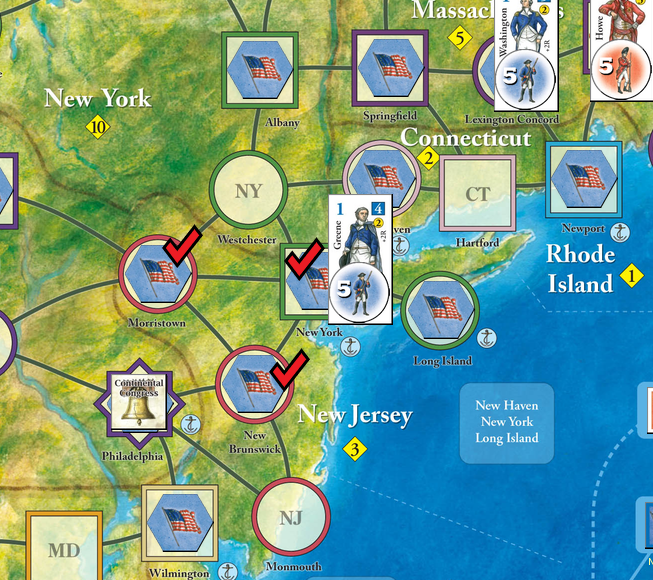
The American wants to provide Philadelphia a little protection against a possible Northern move by Cornwallis. In addition, getting control of New York is a priority for the Americans. The Yanks play a 1 OPs card to move Greene. Green moves three spaces from Newport to New York City.
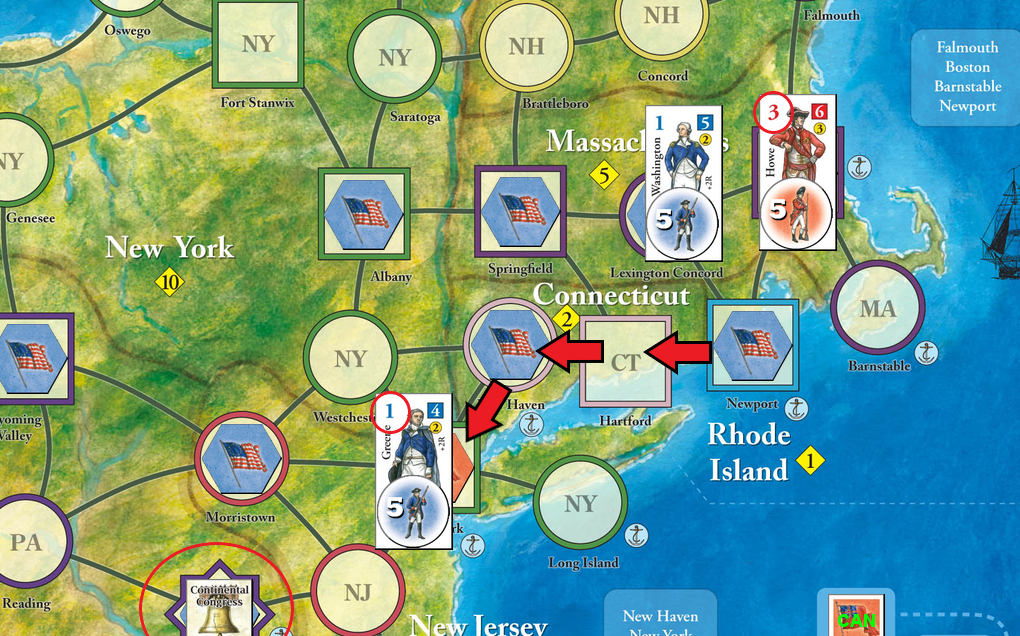
I have circled Philly so you can see that Green is now within easy reach to protect the Continental Congress should Cornwallis advance North. Landing on New York puts Greene in position to establish American political control in a subsequent turn. We will discuss political control actions very shortly.
I have also circled General Greene’s strategy rating of 1 on his unit card. The strategy rating is the minimum OPs number that must be played to activate this general to move and fight. Greene can be activated on OPs 1-3. Since all Ops cards fall in the range of 1-3 General Greene can be activated on any OPs card in the deck. Howe by comparison needs a 3 OPs to activate. Since only a third of the OPs cards are 3OPs, Howe is much more difficult to get moving.
That ends the second card for the American and play goes back to Britain:

The British decide to play a 2OPs card to begin establishing bureaucratic control of their misbehaving colonies. The 2 OPs allows the British player to place political markers on the map. For each OPs point the British may place a control marker. Marker placement will depend on what is currently in the space. Lets break it down to make it easy to understand.
If the space is empty (no control markers or units) then the British can use 1OP to place a British control marker in a space adjacent to an existing British marker. That marker must have been present at the start of the turn. You may not daisy chain markers with a single card.
If the space contains an American control marker, then a British Army (General and at least 1 combat unit) must be present in the space to flip the existing marker from American to British.
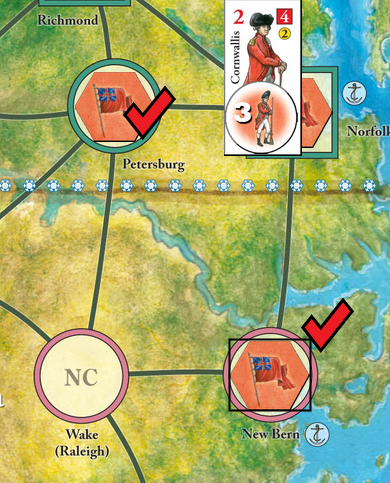
Cornwallis uses 2 OPs to place British Control Markers in New Bern and Petersburg which were previously empty. This action represents the pacification of a region using arrests, offers of amnesty, seizure of armament stores, bribes and placing loyalists in control of government. Britain begins to solidify their control of the Southern Colonies.
Play returns to the Americans for another card. They are currently holding 5 Cards in their hand. They play:

The American player decides that two can play at politics and choses to play 3 OPs in New York and New Jersey for political control. Note that since General Greene is parked on the New York City space he can flip the existing British control marker. He also places new markers in New Brunswick and Long Island which were previously empty of markers. This puts the Americans on very solid footing in New York.
We return to the British player who is holding 5 cards. One of these cards is a special mandatory event card. It will need to be played before the end of the round and it is not particularly useful to the British player.
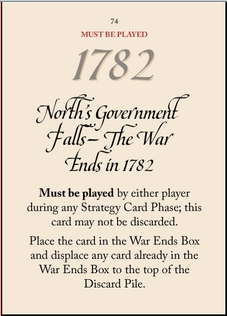
This card determines when the war ends. It gets played on the map in the “War Ends Box” to remind players of the current last year of the game. It can be replaced with other similar cards that may end up in either player’s hand. These cards make sure the players never really know when the game will end. This mechanic is useful to the designer t to prevent players from engaging in “gamey” actions. Knowing when the game will end allows a player to become unrealistically aggressive, for example, because they know there will be no consequences. The card is not useful, however, for the player who finds it in their hand. It’s a dead card that offers no immediate advantage.
Taking a “might as well get this over with” approach the British player plays the 1782 card to get it out of his hand.
We will resume play with the American’s 4th card in the next post.
 Strategic Buffoonery